This blog was generated with AI help.
Key Takeaway
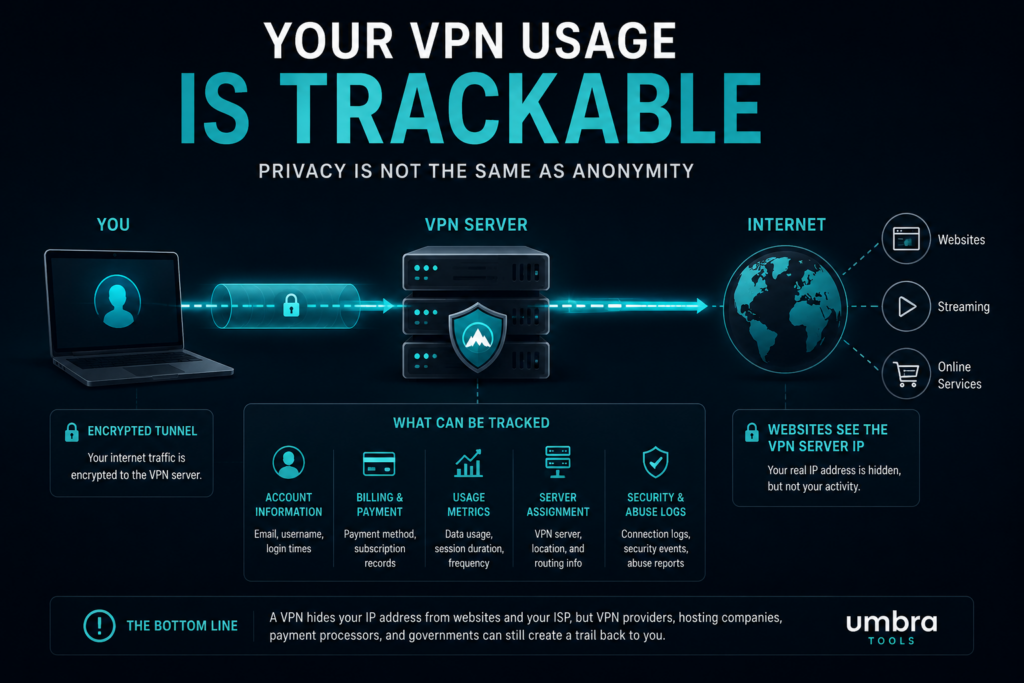
A VPN can improve privacy and security, but it does not automatically make you anonymous. Account creation, payment records, hosting providers, and legal processes can still create links between a VPN service and a user.
What Is a VPN?
A Virtual Private Network (VPN) creates an encrypted connection between your device and a remote server. Websites and online services see the VPN server’s IP address rather than your home internet connection. VPNs are commonly used to:
- Protect traffic on public Wi-Fi
- Reduce ISP visibility into browsing activity
- Access services from different geographic regions
- Secure remote access to networks
The National Institute of Standards and Technology (NIST) defines a VPN as a virtual network built on existing networks that provides a secure communications mechanism for data transmitted between networks. (NIST Computer Security Resource Center)
What a VPN Does Not Do
A VPN does not automatically:
- Make you anonymous
- Prevent websites from identifying you when you log in
- Hide your activity from the VPN provider itself
- Eliminate all records connected to your account
Many VPN advertisements blur the distinction between privacy and anonymity.
The Reality Behind “No Logs” VPN Claims
One of the most common VPN marketing claims is “No Logs.”
At first glance, this sounds like the provider stores absolutely nothing. In reality, the meaning varies significantly between providers. Some services claim they do not store browsing histories while still retaining limited operational, billing, or account information. Independent audits have become the industry’s preferred method for validating no-log claims. (Proton VPN)
Privacy Tip
Don’t trust a “No Logs” claim simply because it appears on a website homepage. Look for:
- Independent third-party audits
- Published audit reports
- Transparent privacy policies
- Court records or legal disclosures
- Technical explanations of logging controls
Security researchers and privacy advocates consistently recommend verifying claims through evidence rather than marketing language. (Tom’s Guide)
If You Have an Account, Someone Knows You Exist
Most VPN providers require users to create an account.
The moment you create an account, the provider gains information that can identify or associate you with that account, such as:
- Email address
- Password credentials
- Subscription status
- Login activity
- Support tickets
Even VPN services that maintain audited no-log policies typically store at least some account information necessary to operate subscriptions and provide support. (GlitchVPN)
This does not mean the provider knows every website you visit. It does mean the provider can generally identify that a specific account exists and has used the service.
Paid VPN Services Create More Records Than Many Users Realize
A common misconception is that using a paid VPN makes a person anonymous. While a VPN can improve privacy, operating a commercial VPN service requires some level of account and infrastructure management.
When a customer purchases a VPN subscription, the provider typically creates records related to:
- Account creation
- Subscription status
- Billing and payment processing
- Customer support interactions
- Service provisioning
Many VPN providers also offer multiple service tiers. Some plans may limit the number of simultaneous devices, available server locations, bandwidth allowances, or premium features. To enforce these limits and manage service quality, providers often need to collect operational metrics about account usage.
This does not necessarily mean the provider is storing detailed browsing histories or the contents of internet traffic. However, the provider may maintain information such as:
- Connection timestamps
- Amount of data transferred
- Number of connected devices
- Server locations used
- Session duration
- Authentication events
Providers may also collect aggregate network statistics to:
- Balance traffic loads
- Detect abuse or attacks
- Troubleshoot performance issues
- Plan future infrastructure capacity
Privacy Reality
Even when a VPN provider operates under a verified no-logs policy, the company may still possess operational metadata needed to run the service. The existence of an account, subscription records, and connection management data means that VPN usage is often more traceable than marketing materials suggest.
VPN Routing Creates Additional Metadata
Every VPN connection passes through one or more servers operated by the provider. To deliver the service, the provider must know which server is handling a connection at any given time.
Depending on the provider’s architecture and policies, operational systems may record information such as:
- Which VPN gateway was assigned to a user session
- Which region or country was selected
- Connection start and end times
- Network performance metrics
- Authentication success or failure events
Again, this is different from storing the websites visited or the contents of communications. However, it demonstrates that operating a VPN service requires more information than simply passing encrypted packets through a tunnel.
For this reason, users should think of VPNs as privacy tools rather than anonymity tools. A VPN can hide your IP address from websites and reduce visibility into your activity by your internet provider, but the VPN company itself still becomes part of the trust chain.
Alternative: Run Your Own VPN Server
Some privacy-conscious users choose to rent a Virtual Private Server (VPS) and install their own VPN software.
Popular options include:
- WireGuard
- OpenVPN
- IPsec VPNs
NIST identifies IPsec VPNs as one of the primary technologies used for secure communications across public networks. (NIST)
Advantages of a self-hosted VPN include:
- Control over configuration
- Control over logging settings
- Ability to audit the system yourself
- Reduced dependence on a third-party VPN company
What Self-Hosting Does Not Solve
A self-hosted VPN does not eliminate all records.
Your VPS provider may still possess:
- Account information
- Billing records
- Server deployment history
- Support tickets
- Infrastructure logs
The trust relationship shifts from a commercial VPN provider to a hosting provider.
Does Deleting the VPS Remove the History?
Some privacy-focused users rebuild or destroy VPS instances regularly.
While this may reduce the amount of data stored on the server itself, it does not guarantee all records disappear.
A hosting provider may retain:
- Account records
- Billing history
- Backups
- Infrastructure logs
- Legal compliance records
Deleting a VPS should be viewed as reducing local retention rather than eliminating every possible historical record.
Important
Destroying a server does not necessarily destroy every record associated with that server.
Governments Can Still Request Information
Whether you use a commercial VPN or your own VPS, a provider may still hold information about your account.
Depending on local laws and jurisdiction, governments and courts may be able to request information from:
- VPN companies
- VPS providers
- Payment processors
- Cloud hosting platforms
The amount of information available depends on:
- Local laws
- Provider policies
- Retention practices
- Whether data was collected in the first place
A strong no-log policy can reduce the amount of information available, but it cannot eliminate information that was legitimately retained for account management or billing purposes. (Proton VPN)
FAQ
Does a VPN make me anonymous?
No. A VPN improves privacy by encrypting traffic and masking your IP address from websites and your ISP, but it does not automatically make you anonymous. Logging into online accounts can still identify you. (NIST Computer Security Resource Center)
Can a VPN provider see my traffic?
Potentially, yes. This is why choosing a trustworthy provider with audited privacy practices is important. Many reputable providers operate under independently audited no-log policies. (Proton VPN)
Is a self-hosted VPN more private?
It can be, because you control the server configuration. However, your VPS provider may still maintain account and billing records.
Are free VPNs safe?
Some are legitimate, but many free VPNs have been criticized for data collection, poor security practices, or inadequate transparency. Privacy experts recommend carefully reviewing policies before using free VPN services. (WIRED)
What should I look for in a VPN?
- Independent audits
- Transparent privacy policies
- Strong encryption
- Clear jurisdiction information
- Minimal account requirements
- Long-term track record
Final Thoughts
VPNs are useful privacy tools, but they are often marketed as anonymity tools.
The reality is more nuanced.
Even if a VPN stores no browsing logs, account information, payment records, and hosting relationships may still exist. Running your own VPN provides additional control, but it does not remove the need to trust a hosting provider.
The best approach is to view VPNs as one layer in a broader privacy strategy rather than a complete solution.
References
- NIST Computer Security Resource Center – Virtual Private Network (VPN) Definition. (NIST Computer Security Resource Center)
- NIST Guide to SSL VPNs. (NIST)
- NIST Guide to IPsec VPNs. (NIST)
- Proton VPN No-Logs Policy and Audit Information. (Proton VPN)
- TorGuard Privacy Policy and Zero Logs Statement. (TorGuard)
- Independent VPN No-Logs Audit Reporting. (TechRadar)
- Industry Analysis of VPN Privacy Claims. (Tom’s Guide)
- Privacy Risks of Free VPN Services. (WIRED)
Leave a Reply